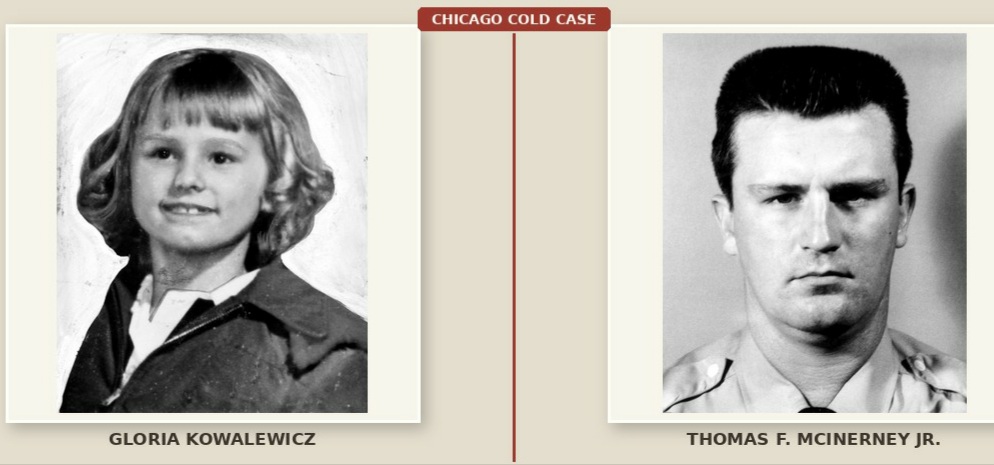
For decades, investigators had physical evidence but no name. Modern DNA analysis, genetic genealogy and a fingerprint comparison eventually led Chicago police to a former officer who had died years before the case was publicly resolved.
On the morning of November 12, 1960, eight-year-old Gloria Kowalewicz left her family's home in Chicago's West Englewood neighborhood to walk a few blocks to Mass. She was a third grader who had recently received her First Communion. Her mother had picked out a pink-and-brown checkered dress for her, and Gloria carried a small white communion purse with a prayer book inside. She never reached the church.
What followed was a major search, a long-running homicide investigation and decades without an answer. In October 2026, the Chicago Police Department's findings were reported publicly: investigators identified Thomas F. McInerney Jr., a former Chicago police officer who later became a homicide detective, as the person responsible for Gloria's killing. McInerney had died in 2006, so he could not be charged or tried in the case.
The most striking part of this story is not just how long it took. It is how evidence gathered in 1960 remained important when forensic methods changed, giving investigators a way to revisit a case that had outlived the people who first worked on it and the parents who waited for answers.

A short walk that ended in tragedy
Gloria disappeared while walking from her West Englewood home to St. Mary of Mount Carmel Church. The route was only a few blocks, a familiar trip for a child living in the neighborhood. Somewhere along the way, she was abducted. Her body was later found in a wooded area of the Palos Hills Forest Preserve, southwest of Chicago, according to CBS Chicago's account of the case.
Contemporary reporting described a search that drew the attention of the wider community. The crime was especially frightening because Gloria had been headed to a nearby church on a routine Saturday morning. The facts are painful enough without embellishment. There is no need to invent what she may have been thinking, add imagined dialogue, or reconstruct moments for which no reliable record is available.
The investigation established that Gloria had been shot. More relevant to understanding how the case was eventually resolved, though, was the material investigators recovered and preserved after her death. Those items would remain in police evidence storage long after the first wave of searches and interviews ended.
The evidence that survived the decades
Investigators collected several pieces of evidence connected to the crime, including a bullet, Gloria's coat and shoes, and the white communion purse that held her prayer book. They also recovered a fingerprint from the purse's strap. Chicago police said the material was carefully inventoried and preserved. CBS Chicago summarized the evidence and the original search, while NBC's reporting gives further detail on the later forensic work.
The value of preserving evidence becomes clear when a case lasts longer than the technology available at the time. In 1960, investigators could collect fingerprints and physical items, interview witnesses and follow leads. But the DNA methods that would later help identify a suspect did not yet exist in their modern form.
Police and community members mounted an extensive search. According to the department's account reported by local news outlets, a task force knocked on hundreds of doors and interviewed more than 1,300 people. More than a dozen people were questioned under polygraph testing. Those efforts generated leads, but investigators did not identify a suspect who could be tied to the crime at the time.
For the family, the case remained an open question. For investigators, the preserved evidence meant the file was not simply a memory of what had happened. Some of its most important clues could still be examined with methods that had not been available in 1960.
The first DNA breakthrough came in 2010
A major step came half a century after the murder. Reporting in the Chicago Tribune says that in July 2010, Chicago police sent Gloria's dress for DNA analysis. Testing identified a male DNA profile from biological material on the garment. The profile was checked against the FBI's Combined DNA Index System, known as CODIS, and investigators developed potential leads. Follow-up testing later excluded those candidates.
That result mattered, but it was not the end of the case. A DNA profile can be useful without immediately identifying a person. A search may produce no match, or an initial lead may fail when investigators test it against additional evidence. That is what happened here: the profile offered a path to pursue, but it did not deliver an answer.
The timeline also involved more than one piece of evidence. In 2024, Chicago police sought FBI assistance to use investigative genetic genealogy with DNA from Gloria's coat. The technique uses genetic information to identify possible biological relatives, then combines those leads with conventional family-history research and other investigative work. The U.S. Department of Justice describes genetic genealogy as a method for generating investigative leads, not as a shortcut that automatically proves guilt.
The distinction matters. A possible genetic relationship points investigators toward a person or family line that may need closer examination. It does not, on its own, settle who committed a crime. The next steps must test and corroborate that lead with other records and evidence.
How investigators identified Thomas McInerney

By July 2026, investigators had identified McInerney as the source of the biological evidence described in reporting on Gloria's case. They then compared fingerprints from his 1959 application to join the Chicago Police Department with the fingerprint preserved from the strap of Gloria's purse. Police said the prints matched.
Reports also describe investigators reviewing firearms information and noting that McInerney had owned Colt revolvers of the type associated with the bullet evidence. Public reporting does not establish that a specific murder weapon was recovered and conclusively matched, so that detail should not be overstated.
Taken together, the DNA work, the fingerprint comparison and the additional forensic review led Chicago police to identify McInerney as the person responsible for Gloria's death. The identification was publicly announced more than 65 years after the killing. The Guardian's October 13 report recounts the central findings and the role played by evidence preserved from the original investigation.
McInerney's identity made the case especially troubling for the department. He had joined the Chicago Police Department in 1959, about a year before Gloria was killed. He became a detective in 1964 and eventually worked in homicide investigations. He retired from the department in 1987 after 28 years of service, according to his Chicago Tribune obituary, republished by Legacy.com.
The connection is disturbing, but the known facts should remain separate from speculation. Public reporting has not established that McInerney participated in the original investigation into Gloria's murder, nor has it established a confirmed prior relationship between him and Gloria. His parents lived less than a mile from her family, but proximity alone does not explain why she was targeted. Investigators have not publicly established a motive.
Why there was no trial
McInerney died in Las Vegas on August 30, 2006, at age 70, according to his obituary. He had left the Chicago Police Department years earlier and later worked as an investigator for federal public defender offices in Nevada. Because investigators identified him after his death, he never faced criminal charges or a trial in Gloria's case.
That is an important distinction when describing a case that police say they have solved. The department's identification is an investigative conclusion supported, according to its public account, by the forensic evidence. It is not a court verdict delivered after a defendant had the chance to challenge the evidence in court.
Gloria's parents had also died before the identification became public. Her younger brother, Adam Kowalewicz, was an infant when she was killed. In comments reported by the Chicago Tribune and other outlets, he expressed relief that investigators had finally named the person responsible, while also expressing frustration that McInerney had died without facing legal accountability. The news could answer a central question for the family, but it could not give them the trial that might have taken place had the identification come earlier.
The Chicago Police Department also acknowledged that Gloria's parents never learned who killed their daughter. Its public statement expressed hope that the news would bring some measure of closure to people who knew Gloria and remembered her story. Closure can mean different things to different families. In this case, it came with a painful limit: the person identified by investigators was no longer alive to answer questions in court.
What questions remain?
The identification answers a major question about who investigators believe killed Gloria. It does not explain why she was targeted. Authorities have not publicly established a motive, and the available reporting does not show a confirmed prior connection between McInerney and the child.
There is also the question of whether preserved evidence or DNA information could help resolve other crimes. The FBI has said it is pursuing investigative leads involving possible unsolved crimes from the same period. That does not mean McInerney has been established as responsible for any other killing. Until investigators publicly connect evidence to another case, any broader claim would be speculation.
The careful approach is to keep those questions open without turning them into theories. In true-crime reporting, an unanswered question is not permission to fill the gap with a dramatic guess. It is a reason to be precise about what authorities have said, what the evidence supports and what remains unknown.
A case changed by evidence that was never thrown away
For more than six decades, Gloria Kowalewicz's case remained unresolved despite a major search and thousands of investigative steps. The breakthrough did not come from a single magic test. It came from evidence collected in 1960, forensic testing in 2010, further genetic genealogy work years later, and fingerprint comparison that gave investigators another way to test the lead.
Gloria was eight years old, walking to church from home. That ordinary detail should not be lost behind the startling fact that the man identified by police later served as a homicide detective. The case is a reminder of both the limits of investigations in their own time and the importance of preserving evidence for methods that may not yet exist.
The identification gave the Kowalewicz family information they had waited decades to learn. It also left questions that may never be fully answered. What can be said with confidence is that the physical evidence from Gloria's case endured long enough for investigators to return to it, test it in new ways and finally put a name to a mystery that had lasted more than 65 years.
Sources and further reading
- NBC Chicago / NBC News: Chicago police find killer in 65-year-old cold case murder of little girl (October 2026)
- CBS Chicago: Former Chicago police officer identified in Gloria Kowalewicz cold case (October 12, 2026)
- The Guardian: Ex-Chicago detective identified as killer in 65-year cold case (October 13, 2026)
- Thomas Francis McInerney Jr. obituary, Chicago Tribune via Legacy.com (September 6, 2006)
- U.S. Department of Justice: Policy on forensic genetic genealogy (September 24, 2019)
- Chicago Tribune report cited by The Guardian (October 11, 2026; may require a subscription)