
On the night of June 11, 1953, an Illinois state representative pulled his car toward a garage on Chicago's West Side. A sedan stopped in front of it. Moments later he was gone. More than seven decades later, no one has been charged and his body has never been found.
The abduction itself is the best-documented part of the story. Almost everything else is disputed: who took Clem Graver, why they did it, and what happened afterward.
Who Clem Graver Was
According to Wikipedia's article on Graver, Celinus "Clem" Graver was born in Chicago on July 4, 1899, one of five children. His father worked in a tannery near Goose Island, and the family was lower-middle class. He grew up around Humboldt Park and attended Lane Tech College Prep High School. He married in 1924, and their only child, a son named Norman, was born in 1925. Later biographical sources identify his wife as Emily Pomazal, while contemporary reports identify her as Amelia. The sources reviewed here do not resolve the discrepancy, so this article refers to her simply as his wife.
His work history was varied.
The same account says he drove a taxicab in the 1920s, spent 12 years as a bailiff for municipal judge Samuel Heller, and worked as an investigator for the Illinois Attorney General. He entered politics through his brother-in-law, Harry Hochstein, a fellow Republican. The article adds that Hochstein later became a close associate of Al Capone.
That last detail matters, but it should be handled carefully. A family tie to a figure with criminal connections is not evidence of why Graver was taken.
By 1946 Graver was Republican committeeman for Chicago's 21st Ward on the city's West Side. By 1953 he was also a state representative. The same article notes that he broke with a legislative bloc over the project that became McCormick Place, though it flags that point as needing further explanation. A separate roundup of Illinois mysteries says he had run for the U.S. House of Representatives in 1942 before winning a seat in the state House.
The Night of June 11, 1953
The Chicago Tribune's front-page report on June 12, 1953 carried the headline "Kidnap Rep. Clem Graver!" Its subheads read "Wife, Friend See Struggle with Captors" and "Seized in Garage Near Home." It identified him as a 53-year-old resident of 976 W. 18th Place, state representative from the 15th District and 21st Ward Republican committeeman. A later summary of Tribune archive reporting identifies the garage as 1013 W. 18th Place, about half a block from his home. The clipping's visible text is only an excerpt, so the fuller narrative below draws on the secondary account.
According to that account, Graver had returned to Chicago by train from Springfield and attended a ward meeting that evening. During the meeting he phoned both his son and his wife, which other attendees reportedly found odd. He also made plans to have lunch with his son the next day. Some people later theorized that he sensed something was coming. That is speculation, and nothing in the record confirms it.
What is reported about the abduction itself:
- Graver was pulling his car into a garage at 1013 W. 18th Place, roughly half a block from the home he shared with his wife at 976 W. 18th Place.
- A black sedan stopped in front of the garage and trapped him there.
- Two men got out, pinned his arms behind his back, and forced him into their car.
- The men were described as well dressed, and a man in a baseball cap was reportedly at the wheel.
- His wife and a friend, fellow Republican Walter Pikelis, watched from the porch.
Accounts differ slightly on what the witnesses did. The Wikipedia article says they watched from the porch. A roundup of Illinois mysteries on Discover HubPages says they tried to intervene without success. That roundup also says Graver typically traveled with armed bodyguards who were absent that day "for reasons unknown." Both points come from a popular summary rather than a primary record, so treat the bodyguard detail as reported rather than confirmed.
A Large Search Without a Resolution
The secondary account describes one of the largest investigations the area had seen. Chicago police formed a special unit, the "Graver Squad," to pursue the case. The account reports the following:
- More than 2,000 people were questioned.
- About 30 arrests were made.
- No one was ever charged in connection with the crime.
- The squad was dissolved in 1958.
Those figures come from the Wikipedia article's summary of the investigation, and the newspaper clippings consulted do not confirm them.
Police initially considered the possibility that Graver had been taken for ransom. An Associated Press report published on June 13, 1953, said a caller told the family, “Clem is O.K.”; it also reported that a police officer stationed at the home said no ransom message had been received at that point. A later Lithuanian-language report in Draugas on August 10, 1954 described five calls from an unidentified person between July 23 and August 1.
The searchable text does not explicitly state the year of those calls. It said the caller initially demanded $4,000 for information about Graver's whereabouts and return, then later demanded $100,000. That report does not establish whether the caller was connected to the kidnappers, so it would be too definitive to say that no ransom demand was ever reported.
In the later stages of the investigation, the same secondary account says, police came to believe Graver had been killed on the day he was taken. That is a reported police belief, not a finding backed by a body or a confession. Contemporary wire-service coverage also named William P. Sheehan and Charles “Specs” di Caro as suspects during the early investigation, but the available reports do not establish that either man carried out the abduction.
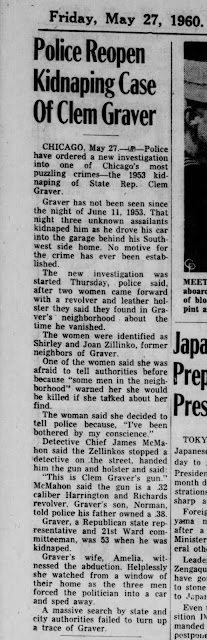
One reported development came in 1960. Two sisters, Jean and Shirley Zelenk, who lived next door to the Gravers, reportedly told police they had witnessed the kidnapping. They handed over a gun in a leather holster that was allegedly Graver's. They said they had waited years because they feared for their lives and had been repeatedly threatened. The Wikipedia article does not say what investigators concluded about the holster or the sisters' account.
Political Ties and Theories: What the Record Can and Cannot Show
Chicago's political world in the 1950s overlapped with organized crime, and Graver's circle was no exception. But no source here establishes a motive or names a perpetrator. The theories below are theories.
| Theory | What is reported | Status |
|---|---|---|
| Organized-crime retaliation | A West Side mob group killed Graver for allegedly tipping off federal law enforcement about its Midwest activities | Popular theory; no proof cited |
| Flight to Cuba | Graver left voluntarily to escape involvement in unlawful activities | Theory; no evidence cited that he went there after disappearing |
| Burial in a construction site | His body lies under the concrete of an underground garage then being built on Michigan Avenue | Theory; no recovery reported |
| Ransom kidnapping | Police initially considered it; a later newspaper report described money demands | The caller's connection to the kidnappers is unverified |
| Killed the day of the abduction | Police's belief in the later stages of the investigation | Belief only; no body found |
The retaliation theory deserves the most caution. The retaliation and flight theories rest on the claim that Graver had something to hide or someone to fear. But the Wikipedia article and the other pages consulted show no evidence that he tipped off anyone, or that he was involved in unlawful activity beyond the allegation itself.
The Cuba theory also remains unproven. A 1978 Chicago Tribune retrospective reported that investigators had discovered several secret trips Graver made to Cuba before the kidnapping. Even if that reporting is accurate, earlier travel does not establish that he fled to Cuba after he disappeared.
The Hochstein connection is the other thread that keeps surfacing. The Illinois roundup says Hochstein was understood to have numerous criminal ties and that he "disappeared himself not long after Graver." He then returned without offering much of an explanation or cooperating much with police. That sequence is intriguing. It does not show that Hochstein knew anything about the abduction, and the Illinois roundup does not claim it does.
Strengths and Limits of the Record
The surviving accounts are useful, but they are uneven.
What the record does well:
- A newspaper published the abduction as news the morning after it happened, with the address, his age, his offices, and the presence of witnesses.
- The core sequence (return from Springfield, ward meeting, garage, sedan, two men) is consistent across the accessible accounts.
- A newspaper returned to the case decades later, which confirms it stayed unresolved.
Where it falls short:
- Investigative figures such as the 2,000 interviews and 30 arrests come from a secondary summary.
- Popular roundups and reference articles repeat theories without the underlying police files.
- Accounts differ on small points, such as whether the witnesses watched or tried to intervene.
- No source here provides a current official case file or agency status.
The Case That Outlasted Its Investigators
By 1978 the case had become something of an annual ritual. In a 1978 Chicago Tribune retrospective by Ann Marie Lipinski, the piece, headlined as noting that the Graver files keep growing and gathering dust without any sign of Graver himself, opens by describing how, every year around the anniversary, detectives and reporters mutter, "Remember Clem Graver?" Most people respond by asking who Graver was.
Occasional optimists ask whether he has been found. Veterans of the yearly inquiry, the piece says, tell them they ought to know better.
That small scene says a good deal. Twenty-five years after the abduction, the files were thick, the trail was cold, and the question was still the same. The visible excerpt of the article does not reveal any new investigative findings, and it should not be read as supplying any.
What Remains Unknown
The central event is established: Graver was seized outside his Chicago home on June 11, 1953, in front of witnesses, and he has not been seen since. Everything after that is open.
- Who took him. No one was ever charged. Contemporary reporting named William P. Sheehan and Charles “Specs” di Caro as suspects, but the sources reviewed here do not establish who carried out the abduction.
- Why. Ransom, political retaliation, and organized-crime motives have all been proposed. None has been proven.
- What happened to him. Police eventually believed he was killed the day he was taken, but this was a belief, not a finding.
- Where he is. His body has never been found. The Michigan Avenue garage theory remains a theory.
The sources describe the case as unsolved and Graver as never found. Nothing supplied here shows a formal closure, a declaration of death, or a current agency determination, so the case should be described as unresolved rather than officially closed.
Frequently Asked Questions
Was Clem Graver actually kidnapped?
Yes. The contemporary Chicago newspaper report the next morning described him as seized in a garage near his home while his wife and a friend watched. Who took him and why remain unknown.
When and where did it happen?
On June 11, 1953, at a garage reported at 1013 W. 18th Place in Chicago, about half a block from his residence at 976 W. 18th Place.
Were ransom demands reported?
An Associated Press report published two days after the kidnapping said a caller told the family, “Clem is O.K.,” while a police officer said no ransom message had been received at that point. A later report in the Lithuanian-language newspaper Draugas said the family received five calls from an unidentified person between July 23 and August 1, with demands rising from $4,000 to $100,000. The searchable text does not explicitly state the year of those calls. The report does not establish whether the caller was connected to the kidnappers.
Did anyone get charged?
No one was charged in connection with the kidnapping. A contemporary wire-service report named William P. Sheehan and Charles “Specs” di Caro as suspects during the investigation, but that report does not establish that either man was responsible. The figures of more than 2,000 people questioned and about 30 arrests come from a secondary summary.
Was his political career the reason he was taken?
That has been speculated, but no source here proves it. His roles as state representative and ward committeeman, and his brother-in-law's reported criminal ties, are context rather than established motive.
Has the case been solved?
No. The sources describe it as unsolved, and Graver's remains have never been located.
Where to Read More
For contemporary reporting, start with the June 12, 1953 Chicago Tribune clipping and the June 13, 1953 Associated Press report linked below. The August 10, 1954 Draugas report is in Lithuanian; the English summary in this article paraphrases the searchable text and should be checked against the original page before quoting it directly. The 1978 Chicago Tribune retrospective offers later context. Wikipedia works best as a reference guide rather than the final authority; its citations point to books and historical newspaper reporting, including work on Chicago politics and police corruption.
References
- Clem Graver — Wikipedia
- Kidnap Rep. Clem Graver! (Chicago Tribune) — Newspapers.com™
- 10 Unsolved Mysteries of Illinois — Discover HubPages
- Clem Graver files grow, get dusty — but still no Clem (Chicago Tribune) - Chicago Tribune Archive — chicagotribune.newspapers.com
- Associated Press report on the kidnapping, republished by The Daily Iowan, June 13, 1953
- Draugas, August 10, 1954 — report on calls to the Graver family (Lithuanian-language source; summarized in English above)
- Police Push Kidnap Probe in Graver Case, June 14, 1953 — Lubbock Avalanche-Journal archive
- Today in Chicago History — Edinburg Post summary based on Tribune archives
