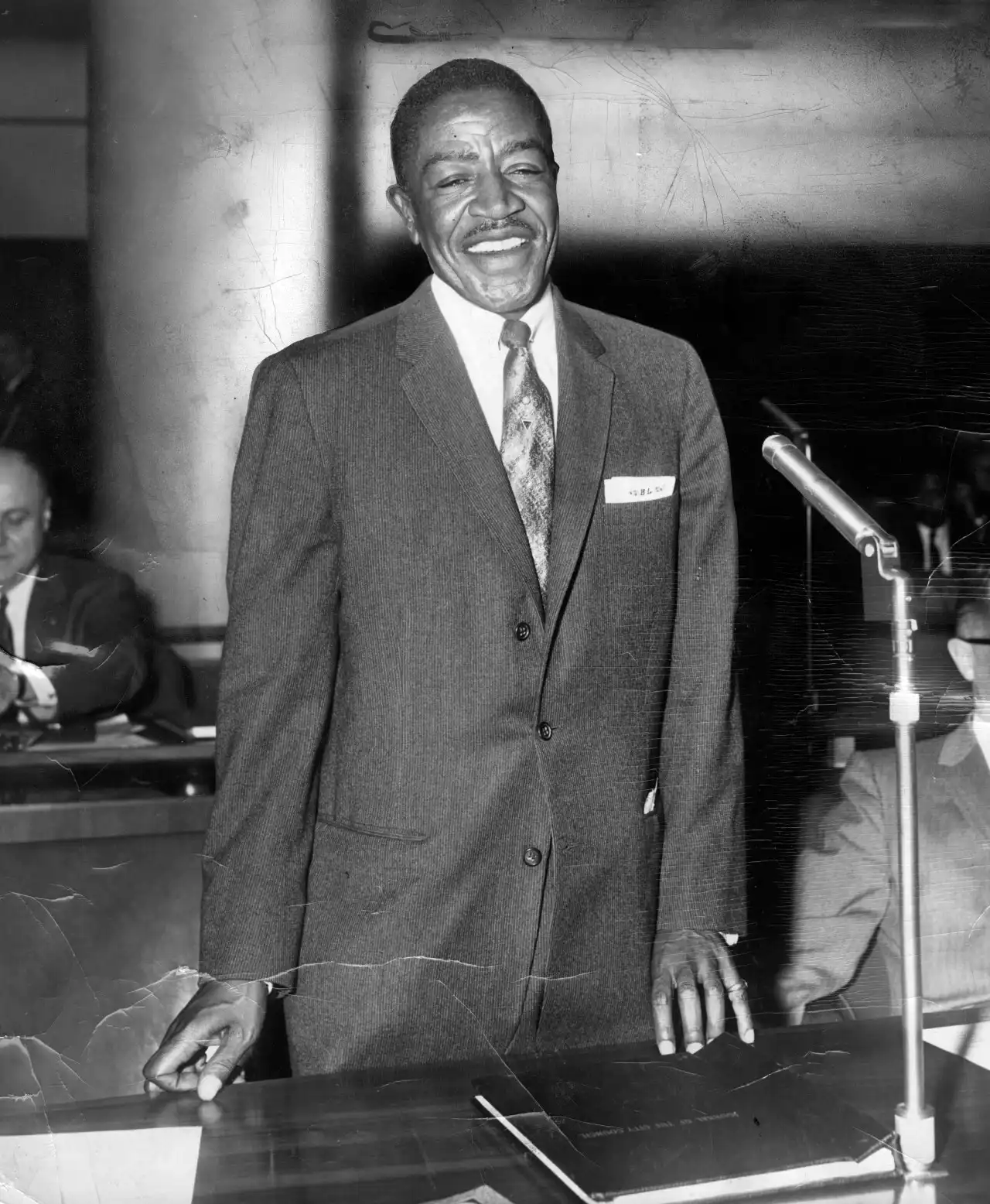
Benjamin Lewis taking his seat as 24th Ward alderman, Chicago City Council, April 17, 1958.
On the morning of February 28, 1963, Chicago Alderman Benjamin F. Lewis was found shot to death in his ward office, two days after winning another term on the City Council. The 2021 ProPublica investigation reported that no one had been brought to justice and police still considered the case open. Lewis is often described as the last elected official murdered in Chicago.
The publicly reviewed sources do not establish a newer official status as of 2026. What follows separates what the record documents from what has only been alleged.
Case at a Glance
A victory, then a killing
On Feb. 26, 1963, Lewis won what was set to be his second full term. Mick Dumke's 2021 ProPublica investigation reports that newspapers were talking about him as a future congressman, with the alderman himself encouraging the talk. Two days later, on the morning of Feb. 28, a maintenance worker found him dead in his ward office.
Accounts of the scene agree on its brutality but differ in detail:
- Dumke's account says a maintenance worker found Lewis facedown behind his desk, in a business suit, arms extended past his head and wrists handcuffed. A cigarette, long burned out, was still held between two fingers of his right hand, and a bloodstained couch cushion covered his head.
- A 2013 ABC7 Chicago retrospective says a janitor found the 53-year-old alderman manacled to his office chair, shot three times in the back of the head with a .38 caliber gun pressed against his scalp. It adds that cigarettes had been burned into his skin.
The sources disagree on whether Lewis was handcuffed to a desk or a chair, and on the firearm caliber. ProPublica's review of investigative records reports a .32-caliber revolver, while ABC7's 2013 retrospective cites .38 caliber. ABC7 quoted a historian saying Lewis had cigarette burns, but ProPublica notes that original police and coroner's records did not document signs of torture. What is consistent is that he was restrained, shot three times at close range, and left in the office.
ABC7 reported in 2013 that the case file was still open. When ProPublica contacted Chicago police for its 2021 investigation, a department spokesperson said the last known activity had been a detective's request for case records in 2000. These are dated reports, not a verified 2026 police-status update.
From Macon to Chicago's 24th Ward
According to the secondary biographical account at Wikipedia's account of his life, Benjamin Franklin Lewis was born in Macon, Georgia, on Dec. 2, 1909. He moved to Chicago's West Side as a child and attended Crane High School and Crane Junior College. He worked as a clerk for the United States Unemployment Service from 1938 to 1941 and served as a second lieutenant in the Army during World War II. After the war he moved into the 24th Ward and drove a bus for the Chicago Transit Authority until he quit in 1955.
The ward he entered was changing fast. It covered the North Lawndale community, long a Russian Jewish stronghold, which became predominantly Black after the 1950s. White political leaders nonetheless held on to control. Wikipedia notes that West Side wards of this kind were known as "plantation wards," in contrast to the South Side, where Black representation went back decades.
The Chicago Justice Project, summarizing an interview with Dumke, gives a political explanation for Lewis's rise. As Black residents moved in, the Daley machine needed to show them it had their interests in mind. In this telling, it recruited and promoted a Black candidate it believed would not challenge the status quo, including mob control of vice and gambling in the community. That is Dumke's interpretation rather than a documented finding, but it frames much of what followed.
Alderman, machine politician and rising figure
According to ProPublica, Lewis had been picked as the first Black precinct captain in the 24th Ward by 1951; the Wikipedia chronology gives 1952. He won a special election as alderman and took office on April 8, 1958, after the previous alderman, Sidney D. Deutsch, left to become city treasurer.
His defeated opponent, attorney Arthur N. Hamilton, went to court alleging election judge misconduct and voter bribery, but a judge dismissed the suit as insufficient.
Lewis was a committed member of Mayor Richard J. Daley's Democratic organization. When Deutsch died in October 1961, Daley picked Lewis as ward committeeman. According to Wikipedia, 37 of the ward's 58 precincts then had white captains. Lewis gradually replaced many of them with Black captains, and he told those who complained to seek patronage jobs from their own ward committeemen.
He won the February 26, 1963 election decisively, although published vote totals differ: ProPublica gives 12,422 to 931, while a contemporary TIME report gives 12,189 to 888. A certified election return was not reviewed here. Wikipedia also reports that he had said he wanted to replace the ailing Rep. Thomas J. O'Brien in Congress, and that he was widely expected to succeed William L. Dawson as Chicago's leading Black political figure.
His public image was flashy. The same account says he liked to be called "Big Cat," took vacations in Acapulco, owned considerable real estate, and wore suits that cost at least $200 each on an $8,000 annual salary. Historian Richard Lindberg told ABC7 that Lewis was living "a million dollar lifestyle" on that salary.
A big gap between income and spending is not proof of wrongdoing, and it was only the impression people formed at the time. Wikipedia's account also says that real power in the ward was held by Irwin Horowitz, a Gold Coast real estate manager.
One documented controversy involved insurance. Lewis referred constituents to his own insurance business while also receiving $50 a month and five percent commissions from the agency Arthur X. Elrod, Inc. for referring clients to it. He reached a settlement with that firm in July 1962 and agreed to stop sending Elrod clients to his own business while the contract ran. That is a conflict-of-interest dispute, not a criminal conviction.
Many in the ward remembered him differently. Alderman Jesse Miller said in 1993 that Lewis was seen as a stalwart who helped make the ward independent.
The crime scene and the first investigation

Crowd lines up for the wake of Ald. Ben Lewis at 3125 Roosevelt Road, March 3, 1963.
Image Credit: Chicago Tribune historical photo.
Dumke reports that police questioned Lewis's wife and girlfriends, and that word leaked that he had been threatened by a jealous husband. Newspapers reported that, like other politicians, he had done business with gamblers and mobsters. Investigators also concluded that a police sergeant was probably the last person to have talked with Lewis, which fed speculation that officers were involved.
Being the last person to speak with someone does not establish involvement in a killing, and nothing in the supplied reporting charges that sergeant with a crime. The investigation soon went cold. ProPublica later examined police and FBI files and found additional unpursued leads.
Contemporary press framing leaned toward organized crime. ABC7 reports that newspapers and magazines covered the murder, one calling it "the return of the rubout," gangland slang for a mob hit. There was no widespread outcry. Wikipedia adds that the director of the investigation, like many at the time, believed the murder was unsolvable because Lewis's activities left too many possible suspects. As ProPublica reported in 2021, Chicago Police spokesperson Luis Agostini said the most recent activity then known to the department was a detective’s request for records in 2000.
Suspects, motives and claims that remain unproven
The Outfit allegation. An FBI informant said shortly after the murder that Chicago Outfit killers Lenny Patrick and Dave Yaras were responsible, according to ABC7. Lindberg placed that in context: the 24th Ward was the home base of what he called the Jewish faction of organized crime, with figures such as "Zucky the Bookie" Zuckerman, Patrick and Yaras overseeing gambling in the district. The government never made a case, and no charges were filed against either man. The allegation remains one informant's claim.
The jealous husband. Reports at the time said Lewis had been threatened by a jealous husband. The reporting describes a threat and no more. Nothing in the supplied accounts shows it was ever tied to the killing.
Gambling and political interests. Lewis's dealings with gamblers and mobsters, his insurance dispute, and his ambitions all offered possible motives. None has been established as the cause.
The 1985 boast. According to ABC7, an ex-convict bragged to neighbors in 1985 that he had killed Lewis. He died in a house fire before police could question him, so the claim was never tested.
How the theories compare
| Theory | What gives it weight | Where it falls short |
|---|---|---|
| Outfit hit (Patrick and Yaras) | An FBI informant named them; the ward was a gambling stronghold; the press called it a mob-style rubout | Informant allegation only; no charges or public proof |
| Personal motive (jealous husband) | Reports of a threat; Lewis had several mistresses | No identified suspect; no evidence tying a threat to the killing |
| Political or business motive | Lewis's machine role, rising ambitions and insurance dispute | A motive is not evidence; no suspect tied to it |
| 1985 confession | A specific boast to neighbors | The man died before he could be questioned; no corroboration reported |
| Police involvement | A sergeant was likely the last to talk with Lewis | Contact is not culpability; no evidence of involvement published |
Why the case may have gone cold
Dumke concluded after interviewing dozens of people and examining thousands of pages of local and federal law enforcement records, court files and political archives that it was no accident authorities never solved the murder. That conclusion is a reporter's interpretation, not a judicial finding. His reporting places Lewis's death in an era when white officials and gangsters worked to control and profit from Black communities, often through violence, and presents the case as an illustration of political corruption, police misconduct and systemic racism.
ProPublica cites an FBI agent's report summarizing an informant's allegation that stories about Lewis's personal life were being fabricated to damage his reputation and reduce public sympathy. A Chicago Justice Project discussion interpreted this as political-machine rumor spreading. The underlying allegation does not establish who originated the stories, or prove a directed cover-up. Dumke's investigation explores the political, policing, and organized-crime interests that may have benefited from the murder going unsolved; it does not identify a proven killer.
The line between documented context and proven obstruction matters here. Overlapping political, police and criminal interests are well described. What the supplied reporting does not offer is proof that any named official or officer deliberately blocked the investigation.
An investigation that goes cold can reflect cover-up, but it can also reflect a lack of evidence or a lack of will to pursue the case. Dumke argues that investigative omissions reflected the political climate, while the available reporting does not prove that a specific named official deliberately obstructed the investigation.
What the record establishes, and what it does not
| Issue | What the sources report | What remains unestablished |
|---|---|---|
| Date and place | Found dead Feb. 28, 1963, in his 24th Ward office on Roosevelt Road, two days after re-election | The exact time of death is described differently across accounts |
| Crime scene | Handcuffed and shot three times. ABC7 reports .38 caliber; ProPublica, citing investigative records, reports .32 caliber. | Precise restraint location (desk or chair), the caliber discrepancy, and whether torture occurred; contemporary police/coroner records cited by ProPublica did not document torture. |
| Outfit allegation | An FBI informant named Lenny Patrick and Dave Yaras | Any charge, corroboration or public proof |
| Personal motive | Reports of a threat from a jealous husband | Any link between the threat and the murder |
| Political and gambling motives | Ties to gamblers and mobsters; a rising profile; documented conflict-of-interest dispute | Which motive, if any, drove the killing |
| 1985 confession claim | An ex-convict boasted to neighbors; he died in a house fire | Whether the claim was true |
| Case status | Police said the case remained open in reporting from 2013 and 2021. In 2021, CPD said the last known case activity was a detective requesting records in 2000. | Any case-status change after the 2021 reporting, and whether the murder can still be solved. |
Pros and cons of the main lines of inquiry
Strengths of the organized-crime theory
- A specific informant allegation, made soon after the killing
- A ward known to be a center of gambling
- A reported mode of killing that contemporaries called a mob-style rubout
Weaknesses
- It rests on a single informant
- No charges were ever brought
- It does not explain why authorities did not press the case
Strengths of the personal-motive theory
- Police took the threat seriously enough to question wife and girlfriends
Weaknesses
- No suspect was publicly identified, and the claim was never connected to the evidence
Memory, legacy and the unanswered questions
Lewis left a mixed legacy. He was a machine-aligned politician whose rise nonetheless marked a shift in representation, and he was the first Black alderman of a ward long dominated by others. Some residents remembered him as a pioneer for the community. In 1993 the City Council designated Pulaski Road between Harrison Street and Cermak Road as Benjamin F. Lewis Road. ABC7 notes that it remains unclear whether he dishonored his office.
His seat stayed vacant until George W. Collins took it on Jan. 21, 1964. The killing also took its place in Chicago's long record of political violence. Lindberg argued it capped off open lawlessness toward politicians going back to Al Capone's time, and said it was one of roughly 1,000 unsolved murders attributed to organized crime. Dumke connects it to the neglect and disinvestment that continue to affect West Side neighborhoods, and says the case remained an open wound for many longtime residents.
Three questions remain open:
- Who carried out the killing, and who, if anyone, ordered it?
- Which motive mattered most: money, politics, personal conflict or something else?
- Could a more thorough investigation, in a city less entangled with the people involved, have produced answers?
Frequently asked questions
Who killed Ben Lewis?
No one knows. Nobody has been charged or convicted. An FBI informant blamed Outfit figures Lenny Patrick and Dave Yaras, and an ex-convict boasted of the crime in 1985, but neither claim was proven.
When and where was he killed?
He was found dead Feb. 28, 1963, in his ward office on Roosevelt Road in Chicago's 24th Ward. He had won re-election two days earlier.
Was Lewis corrupt?
Reports describe a lavish lifestyle on an $8,000 salary and a settled dispute over insurance referrals. Those are documented controversies, not proven crimes. ABC7 says it is unclear whether he dishonored his position.
Was the Chicago Police Department involved?
A police sergeant was reportedly among the last people to speak with Lewis, which fueled speculation. That fact alone does not show involvement, and no evidence of police participation has been published in the supplied reporting.
References
- ProPublica (2021) — The Murder Chicago Didn’t Want to Solve; Mick Dumke
- ABC7 Chicago (2013) — 50 Years Later, Alderman Murder Still Open Case
- TIME (March 8, 1963) — Crime: Return of the Rub-Out
- Chicago Justice Project (2021) — Discussion With ProPublica Reporter Mick Dumke
- U.S. House of Representatives — George W. Collins Historical Biography
- Wikipedia — Benjamin F. Lewis (secondary biography; verify against primary records where possible)
'Cold Cases' 카테고리의 다른 글
| Paula Jean Prince — (1946-1982) (0) | 2026.11.05 |
|---|---|
| Yasmin Rayon Acree — (2008) Missing Case (0) | 2026.11.04 |
| Nancie Carolyn Walker — (1947-2003) (0) | 2026.11.02 |
| The Jesse Warren Ross Missing Case — (2006) (0) | 2026.11.01 |
| The Kevin Clewer Case — (2004) (0) | 2026.10.31 |
