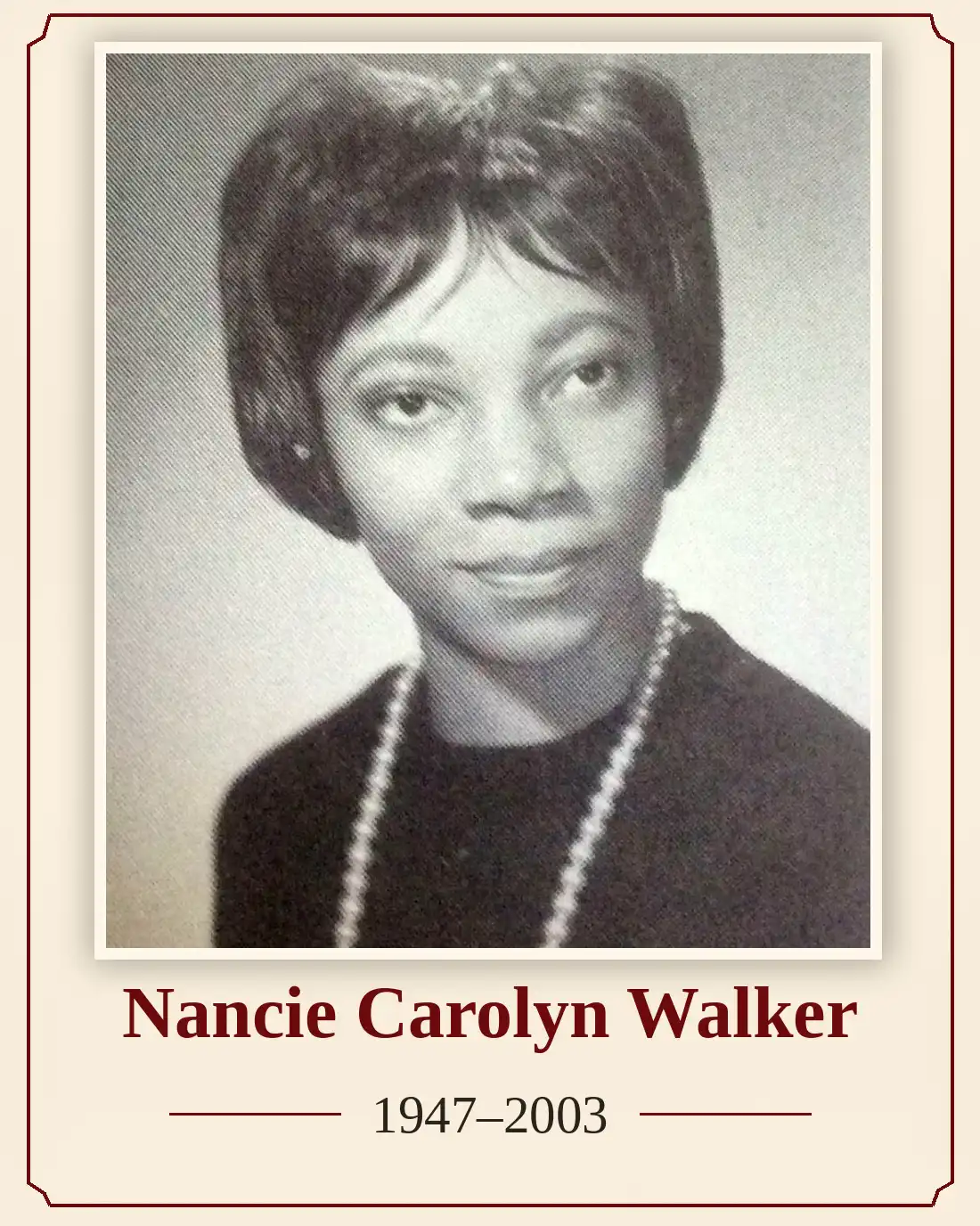
Nancie Carolyn Walker (1947 - 2003)
Nancie Carolyn Walker was a 55-year-old Chicago businesswoman, dancer and eldest of six sisters when she vanished in January 2003. Seven weeks later, her dismembered remains were found in trash bags along a Chicago expressway. The available reporting identifies no suspect, arrest or prosecution, and describes her killing as unresolved.
This article sets out what her family and published reporting say about her life, her disappearance, the discovery of her remains and the questions that remain open. It also marks clearly where the public record is silent.
Case at a Glance
Nancie Walker Was More Than the Way She Died
Those closest to her called her Carolyn. According to a profile by journalism professor John W. Fountain, published in a Roosevelt University student reporting project, she was born on Aug. 15, 1947, in Birmingham, Alabama, and was the eldest of six sisters. Her family moved to Chicago in 1961.
They first lived on the 13th floor of a public housing building at 4445 S. Cottage Grove Ave. A few years later they moved into a house of their own, which the family still owns.
Walker attended Francis W. Parker School on Chicago's Near North Side, where she was captain of the cheerleading squad. Dance was the constant in her life: modern dance was a favorite style, and she later studied jazz and ballet. She attended Columbia College, where she majored in accounting. The profile describes this as a choice meant to offer more longevity and income than dance. She also attended Roosevelt University.
She never left dance behind. Walker opened her own studio in Englewood, where she taught yoga and jazzercise. She also danced with her Buddhist community in Dance SGI (Soka Gakkai International) Chicago. Family members remember her as someone who loved to "step," the Chicago style of ballroom dancing set to R&B. She also loved trying different restaurants.
Her business life was equally full. The profile reports that she became landlord of five residential buildings she had purchased, and that she also ran a beauty salon and a trucking company.
Even as a child, she dreamed of being an entrepreneur so she would never have to work for anyone else. Delmarie Cobb, her longtime friend and onetime roommate, described Walker as "an entrepreneur at heart."
Her sister Myrna Walker described her as a "best friend" and recalled that Nancie would come downtown most days so the two could have lunch together. This portrait rests on family interviews and reporting published in 2020. It is a remembrance written by those who loved her, not a neutral biographical record.
A Disappearance That Alarmed Her Family
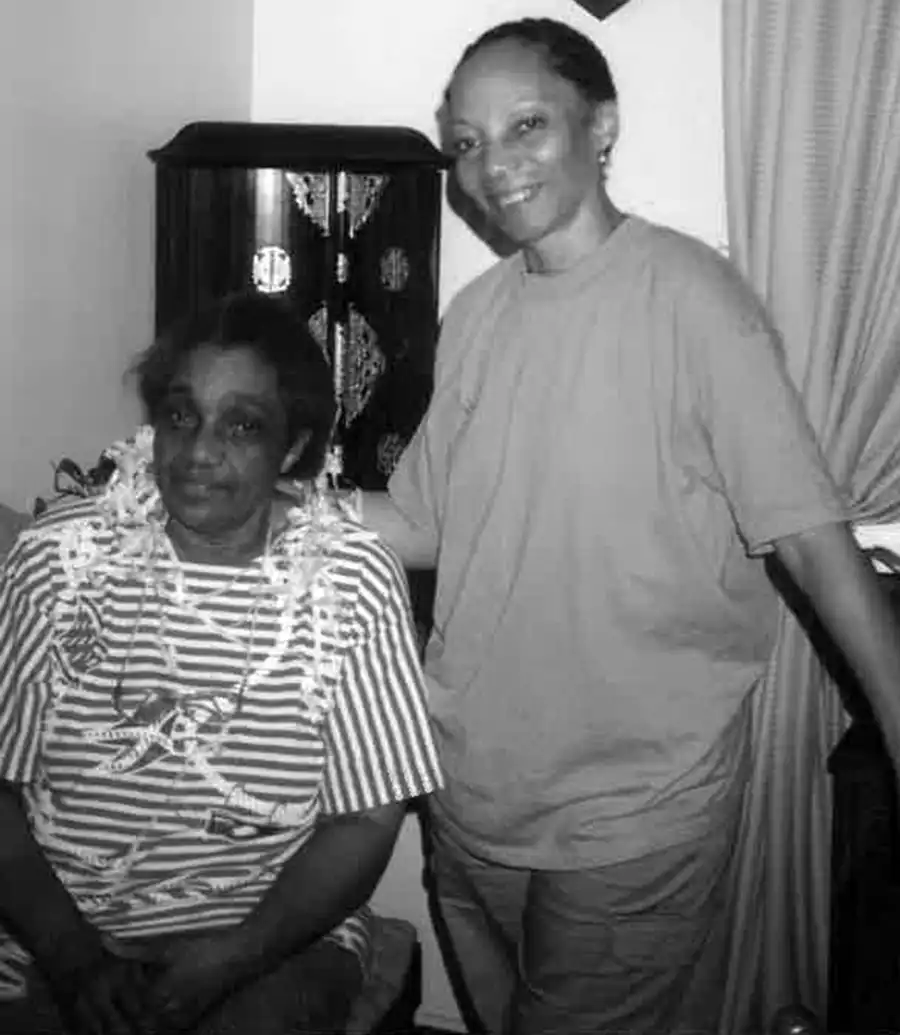
Nancie with Mother Willie C. Anderson. Image source: Family collection
The family's account places the last contact with Walker in January 2003, on what the profile calls an unseasonably warm but overcast winter day. The public reporting does not give an exact date or a precise last-seen time, so none is stated here.
According to Myrna Walker, the sisters usually talked every morning. Nancie had called to say she was on her way downtown to meet Myrna for lunch, but she never arrived.
Myrna waited, then called repeatedly through the evening and the following day. No one answered.
Two days later, on a Thursday, the family's concern deepened. Nancie led dance classes with her Buddhist dance troupe on Thursdays and, by the family's account, never missed one.
When Myrna called and learned Nancie had not shown up, she said that was when she knew something was wrong. Myrna then went to her sister's house. Inside, she could tell Nancie had not been there in a while.
Cobb, a former television news reporter and longtime media and political consultant, remembers receiving the call that Walker was missing.
Two details from the family's account bear on how they understood the disappearance:
- Walker had made a run to the bank on the day she disappeared, according to the family.
- She was a working businesswoman, and the family said it made no sense that she would simply walk away from her life.
These are the family's recollections. The profile does not describe any independent verification of her movements on her last day. In a separate June 2022 FOX 32 interview, Myrna relayed an account that Nancie had entered a black van with two men near her salon. That report does not independently establish who the men were or how the reported sighting relates to her last call to Myrna.
The Search and the Family's Criticism of the Police Response
The family reported Walker missing to police. They said officers were not moved to urgent action. In their account, police treated the case as a routine instance of an adult walking away from home. Officers raised possibilities such as a domestic situation, alcohol or drugs, and the family said police told them to wait until Monday.
Cobb remembers rejecting that advice. She helped the family organize a press conference at a South Side beauty salon. Over the following days, Myrna, her sisters and Cobb pressed police to list Walker as a missing person on the police website. They also worked to saturate the city with her picture and searched for her themselves.
The family and Cobb also pointed to a gap in public attention. In early 2003, the disappearance of Laci Peterson, a white woman from Modesto, California, dominated national headlines. Cobb recalled that a local newspaper ran Peterson's story on page one and a story about Nancie on page 57.
The profile also contrasts the 2002 disappearance of Alexis Patterson, a 7-year-old Black girl from Milwaukee, with the heavy coverage of Elizabeth Smart, a white teenager abducted in Utah.
These are the perspectives of the family, Cobb and the reporters who profiled them. The Roosevelt University profile does not show that unequal coverage caused any specific investigative failure in Walker's case. They do show how the people closest to her experienced the response.
Cobb's summary of that experience was that it seemed as if Black women's lives are treated as having no value. In a separate Washington Post interview published in June 2022, Myrna again criticized the way police handled her sister's disappearance.
Seven Weeks Later: Her Remains Were Found
The central reported timeline comes from two publications by the same journalist, John W. Fountain: the Roosevelt student project profile and a Chicago Sun-Times column introducing the project. They agree on the main facts but are not independent investigations.
On March 19, 2003, seven weeks after the family reported her missing, Walker's remains were found. She was 55. Her body had been dismembered, and the parts were placed in trash bags left along the Bishop Ford Highway. The Sun-Times column refers to the same roadway as the Bishop Ford Freeway.
Later independent accounts in The Washington Post and FOX 32 also describe the recovery along an expressway; FOX 32 describes 63 days after Walker went missing, while Fountain describes seven weeks after the family reported her missing. These could measure different starting points; the exact dates of the disappearance and police report remain unverified in the reviewed sources.
The reporting stops there. Neither source provides:
- an official cause or manner of death;
- forensic findings;
- how, when or by whom the remains were left at the roadside;
- the date Walker was last seen alive, or the interval between her death and the discovery.
The absence of these details in published reporting does not mean investigators lack them. It means they are not stated in the Roosevelt University profile or the Sun-Times column.
What the Public Record Shows About the Investigation
The reporting describes Walker's case as unsolved. It names no suspect, reports no arrest or prosecution, discloses no physical evidence, and offers no detailed investigative chronology. The profile says her case, like those of many other slain Chicago Black women, "has grown cold over time." It adds that the family sees the authorities' handling of such cases as never more than lukewarm to begin with.
Walker is one of 51 women covered by a Roosevelt University student journalism project. Over two semesters, student reporters investigated the unsolved strangulation murders of at least 51 Chicago women over two decades. According to the project's description, more than three-quarters of the women were African American. The Murder Accountability Project, a nonprofit research group in Alexandria, Virginia, studies homicide data. It used algorithms to conclude that the killings are the work of one or more serial killers.
The project page states that Chicago police continue to investigate.
That broader hypothesis needs careful handling. The sources attribute the serial-killer conclusion to the Murder Accountability Project's analysis of the group of cases.
They do not present evidence that ties Walker's killing to a particular offender, and they do not show what method of death applied to her. The project describes the group as strangulation murders, but the two original Fountain publications do not state an official medical determination of how Walker died. A 2022 FOX 32 interview quotes her sister describing strangulation, but that statement is not the same as an independently reviewed medical examiner report.
The group-level finding therefore does not establish that a serial killer murdered Walker, and it does not prove a link among any of the cases.
In June 2022 reporting by FOX 32, Chicago Police Department spokesperson Tom Ahern said detectives assigned to an FBI violent-crimes task force had reviewed the deaths and found no evidence linking the cases to one another or showing a single serial killer was responsible. He said detectives were investigating them individually.
This is a police statement quoted by a news outlet, not a released case file on Walker's individual homicide; it does not resolve her case.
What the Public Reporting Does Well, and Where It Falls Short
| Strengths | Limits |
|---|---|
| Detailed, family-sourced account of Walker's life, work and relationships | Based largely on interviews with relatives and a friend, so it reflects their recollections |
| Clear timeline anchor: remains found March 19, 2003, seven weeks after the disappearance | No exact disappearance date or last-seen time given |
| Documents the family's criticism of the initial police response | No police account of that response appears in the profile |
| Places the case within a wider group of unsolved killings | The group-level analysis does not prove a connection to Walker's case |
A Family Left With Grief and Unanswered Questions
The reporting shows grief that has outlasted the years. Myrna Walker, then 70, described the emptiness after her sister's death. She said she would go places without remembering how she got there, could not sleep or eat, and felt guilty that she could still eat when Nancie could not.
She developed shingles, lost weight and underwent therapy for five years. She still dreams of her sister regularly.
Justice, for her, is an uncertain concept now. She said her mother is old and the sisters are all older. They are almost at the point of not wanting to relive what happened, and she questioned whether she could bear a trial. Their mother, Willie Walker Anderson, then 89, was described as still carrying the agony of losing a daughter to murder without justice having come.
Cobb remains committed. She believes someone is out there who thinks they got away with murder, and she says the family and friends cannot let that stand. Each of Walker's sisters keeps a share of her ashes in an urn.
The Roosevelt University profile does not say whether Walker's case is being actively investigated today, and it gives no current official contact for tips.
Anyone with information should contact the Chicago Police Department directly and confirm current procedures. This article does not list a tip line because none appears in the reporting.
Key Facts and Unresolved Points
| Item | What the reporting states |
|---|---|
| Name and age | Nancie Carolyn Walker, called Carolyn by those closest to her; 55 when her remains were found |
| Born | Aug. 15, 1947, Birmingham, Alabama |
| Last known period | January 2003; exact date and time not stated |
| Remains found | March 19, 2003, in trash bags along the Bishop Ford Highway (also called the Bishop Ford Freeway); the reviewed reports do not specify the precise municipal recovery location |
| Time missing | Seven weeks |
| Status | Described as unsolved and cold |
| Publicly reported suspect or arrest | None stated in the available reporting |
| Cause and manner of death | Not stated in the available reporting |
| Forensic details | Not stated in the available reporting |
| Link to a serial killer | Not established; the Murder Accountability Project's analysis covers a group of 51 cases |
| Current investigative status and tip contact | Not stated in the available reporting |
Frequently Asked Questions
Who was Nancie Carolyn Walker?
Walker was born in Birmingham, Alabama, on Aug. 15, 1947, and moved with her family to Chicago in 1961. She was the eldest of six sisters, a dancer, a cheerleading captain at Francis W. Parker School, and a Columbia College student who majored in accounting. She taught yoga and jazzercise at her own Englewood studio and danced with a Buddhist community group. She was also a landlord, salon owner and trucking company owner. Family and friends knew her as Carolyn.
When and where were her remains found?
Her remains were found on March 19, 2003, seven weeks after the family reported her missing. According to the reporting, they were in trash bags along the Bishop Ford Highway. The reviewed reports do not establish the exact municipal recovery location. She was 55.
Was her murder solved?
No. The reporting describes the case as unsolved and cold. It identifies no perpetrator, suspect, arrest or prosecution. A June 2022 Washington Post report also described her death as unresolved; that reporting alone cannot establish the case's current 2026 status.
Is there evidence linking her case to a serial killer?
The reporting does not establish a link. The Murder Accountability Project concluded from its analysis that 51 Chicago women's killings, including Walker's, were the work of one or more serial killers. The Roosevelt University profile presents no case-specific evidence connecting Walker's death to a particular killer or to any other victim.
Why does the family say the case received little attention?
Family members and Cobb said police initially treated her disappearance as a voluntary absence and that media coverage was sparse compared with high-profile cases involving white women. These are their accounts and their interpretation. The Roosevelt University profile does not show that these factors changed the investigation's outcome.
References
- Unforgotten51: Portraits of Life: Stolen 'Like Ashes In A Violent Wind' — unforgotten51.com
- Unforgotten: The untold story of murder Chicago women — Chicago Sun-Times
- Silenced Prey: Unsolved strangulation murders of Black women in Chicago — FOX 32 Chicago (June 2022)
- In Chicago, march highlights unsolved cases of missing Black women — The Washington Post (June 2022)
- School History — Francis W. Parker School (official website)
'Cold Cases' 카테고리의 다른 글
| The Jesse Warren Ross Missing Case — (2006) (0) | 2026.11.01 |
|---|---|
| The Kevin Clewer Case — (2004) (0) | 2026.10.31 |
| Mary Agnes Moroney — (1930) (0) | 2026.10.30 |
| Elsie Paroubek — (1906-1911) (0) | 2026.10.29 |
| The Ioan Petru Culianu Case — 1991 (0) | 2026.10.28 |
