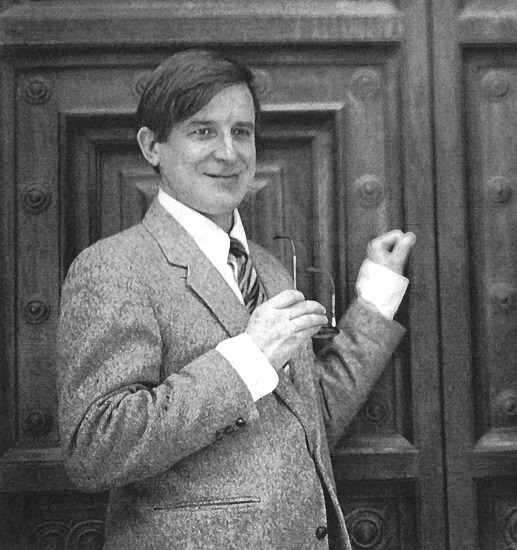
On May 21, 1991, Ioan Petru Culianu, a 41-year-old Romanian-born historian of religions, was shot dead in a restroom at the University of Chicago Divinity School. More than three decades later, no one has been identified as the killer and no motive has been established. The case has drawn theories involving Romanian security services, Romanian far-right circles and the bitter legacy of Culianu's mentor, Mircea Eliade. None of these theories has been proven. This article separates what is documented from what is only suggested.
Ioan Petru Culianu
Case: Unsolved homicide
Date of death: May 21, 1991
Age: 41
Location: Swift Hall, University of Chicago
Occupation: Historian of religions; university scholar
Reported cause: Gunshot wound to the head
Case status: Unsolved; perpetrator and motive unknown in the cited record
Sources: University of Chicago Library and Wikipedia biography.
A scholar whose life crossed borders
Culianu was born in Iași, Romania, on January 5, 1950. According to the University of Chicago Library's finding aid for his papers, he studied at the University of Bucharest and in Italy, eventually earned three doctoral degrees (including a Ph.D. from the University of Paris in 1987), and wrote proficiently in six languages.
He lived in France and the Netherlands before arriving in Chicago as a visiting lecturer and then joining the Divinity School faculty.
His specialty was the history of Renaissance magic and mysticism, with a strong focus on Gnosticism. The same archival guide lists Eros and Magic in the Renaissance, The Tree of Gnosis and Out of the World among his best-known works.
He also wrote fiction and essays, including political pieces opposing Romania's post-revolution regime.
The fuller sequence of his migration is laid out in a Wikipedia biography. He graduated from Bucharest in May 1972 with a major in Italian language and literature, then traveled to Italy, where he was granted political asylum in July 1972.
He received a doctorate in the history of religion from the Università Cattolica del Sacro Cuore in Milan in November 1975. From 1976 to 1985 he taught at the University of Groningen in the Netherlands, and he left Europe for the United States in 1986.
He became a U.S. permanent resident in January 1991. At the time of his death he was engaged to Hillary Wiesner, a Harvard graduate student, and had divorced his first wife.
The Eliade relationship
Eliade, the Romanian-born historian of religion who taught at Chicago, was Culianu's mentor. The Christian Century's review of Bruce Lincoln's book on the case reports that Eliade was so impressed with Culianu that he named him literary executor and heir apparent, and that this helped Culianu win a permanent faculty appointment after Eliade died in 1986.
The same review describes a relationship that grew "vexed" as evidence of Eliade's 1930s ties to the Romanian fascist Iron Guard (the Legion of St. Michael) came to light. Culianu tried to maintain both scholarly integrity and loyalty to his mentor. Other accounts, including Radio România Internațional's overview of the case, say the two eventually separated over the revelation of Eliade's fascist past.
This biography does not by itself explain a murder. Culianu's field and his mentor are context, not evidence of a motive.
May 21, 1991: the killing in Swift Hall
The core facts are consistent across sources. Culianu was killed on Tuesday, May 21, 1991, in a restroom in Swift Hall, home of the University of Chicago Divinity School. He was shot in the head from behind. Wikipedia, citing Ted Anton's reporting, says he was shot once in the back of the head with a .25 caliber automatic weapon.
It places the killing at about noon, just minutes after he finished talking with his doctoral student Alexander Argüelles, on a day when the building was busy with visitors to a book sale.
Other accounts vary in precision:
- Radio România Internațional says Culianu was found dead around 1 p.m. in a restroom of a University of Chicago building. It does not say when he was shot.
- The Christian Century's review describes a men's room stall.
- A 2025 essay on the case from Progressive Geographies places the shooting in the third-floor bathroom of Swift Hall and calls the killing "seemingly professional." That characterization is the author's impression, not a forensic finding.
The sources reviewed do not offer a verified reconstruction of how the killer entered or left the building, and this article does not supply one. A plaque commemorating Culianu now stands outside the restroom, according to the same essay's author, who visited.
The known timeline, and its gaps
| Date | Event |
|---|---|
| January 5, 1950 | Born in Iași, Romania |
| May 1972 | Graduates from the University of Bucharest |
| July 1972 | Granted political asylum in Italy |
| November 1975 | Doctorate, Università Cattolica del Sacro Cuore, Milan |
| 1976–1985 | Teaches at the University of Groningen |
| 1986 | Moves to the United States; Mircea Eliade dies |
| January 1987 | Second doctorate, University of Paris IV |
| December 1989 | Romanian Revolution and the death of Nicolae Ceaușescu |
| Early 1991 | Becomes a U.S. permanent resident (January); publishes critical articles and interviews on the post-revolution government |
| May 21, 1991 | Shot dead in a Swift Hall restroom |
| July 1991 | Due to receive a permanent appointment at Chicago (as reported by Wikipedia; other accounts describe an earlier appointment) |
Accounts differ slightly on when his Chicago position began. Wikipedia says he served as a professor from 1988, while the Christian Century frames his permanent appointment as following Eliade's death.
The sources also contain no independently verified, minute-by-minute account of May 21 beyond the details above.
Investigation, evidence, and what remains unknown
The reported investigative outcome is simple: the killer and the motive have not been identified. Radio România Internațional states that despite thorough investigations, the perpetrator or perpetrators were never found, and the crime remains a mystery. The Wikipedia entry says the same.
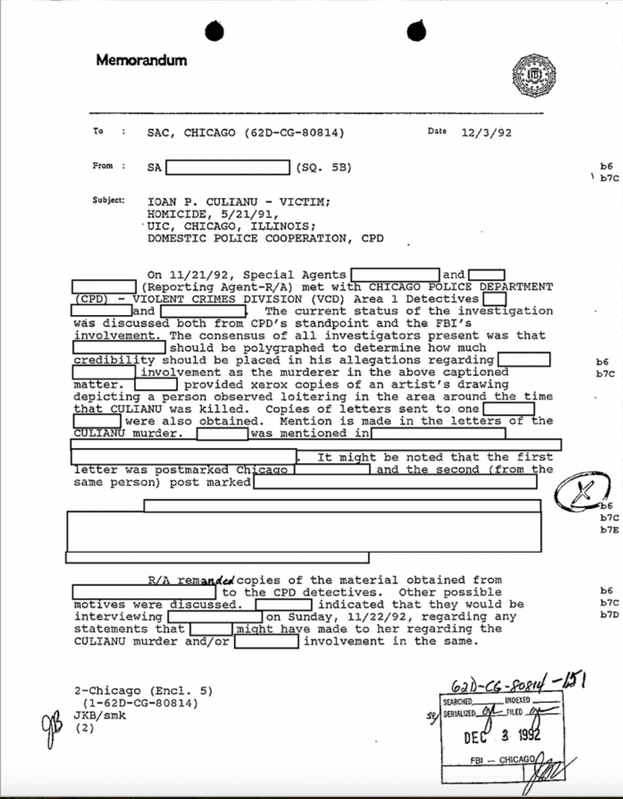
FBI records exist, though they offer little to the public. The author of the Progressive Geographies essay notes that the FBI's online vault lists three files of 489, 324 and 227 pages. The second and third appear blank when downloaded but can be read online, and the files contain repetition, cover sheets, newsclippings and heavy redaction.
Two scholars interviewed by Radio România Internațional describe the same wall. Moshe Idel, a historian of religions at the Hebrew University of Jerusalem, says the FBI effectively gave up after several years of work, leaving a file in which nothing was resolved. He also recounts asking Romania's then-president, Emil Constantinescu, why the question was not clarified; by Idel's account, the president said he could do nothing. Historian Sorin Antohi says the family's efforts led nowhere and that thousands of declassified pages published by U.S. authorities are anonymized or blacked out.
What the sources do not supply is equally important. They contain no complete police case file, no forensic inventory, no witness list and no confirmed suspect. Anything beyond the shooting and the unsolved status is interpretation.
Political theories: Romanian security services and the far right
The leading theories grow from Culianu's politics. Wikipedia's account says he published articles and interviews heavily criticizing the post-revolution government of Ion Iliescu, making him one of its most vocal adversaries,
and that the murder came a year and a half after the December 1989 revolution. Several theories link the killing to the Romanian Intelligence Service, widely perceived as the Securitate's successor.
The same entry notes that some reports mention anonymous threatening phone calls in the days before the killing, and that several pages of his Securitate files are inexplicably missing.
The Christian Century's reviewer summarizes the main hypotheses: Ted Anton proposed that agents of the Romanian secret police assassinated Culianu after he mocked the regime in satirical articles, while others have suggested Chicago-based legionaries who saw him as a traitor.
The Progressive Geographies essay adds Anton's argument that a motive tied to Eliade's papers is weak, because by 1991 those papers had been dispersed or published and there were "no secret Iron Guard papers" to protect.
It also reports an observation from Paris dissident Monica Lovinescu that rumors blaming the Iron Guard often point instead to the Securitate. Umberto Eco, reviewing Anton's book, noted that Culianu was killed "in a manner typical of the methods of Eastern European security services." That is a judgment about method, not a finding.
Radio România Internațional says the most widely circulated scenarios involve the former communist Securitate and the Romanian fascist exile community.
Two cautions apply. First, none of these sources establishes that either the Securitate or the far right was responsible. Second, the manner of the shooting,
the political context and the reported threats are circumstantial. They explain why the theories exist but do not prove any of them.
The Eliade connection and a disputed personal theory
The Eliade controversy gives the case a second thread. The Christian Century's review says that in the 1930s Eliade became deeply involved in the Iron Guard, a nationalist, antisemitic and anti-democratic movement, and that he later denied the full extent of that involvement without ever fully renouncing it.
Culianu and the biographer Mac Linscott Ricketts planned to publish translations of Eliade's pro-legionary articles with scholarly commentary.
When Eliade's widow, Christinel, learned of the plan, she derailed it by asserting her sole prerogative as literary executor.
The review adds that after receiving death threats, shortly before his murder, Culianu entrusted the translations to a colleague, who passed them to Lincoln.
The question of who held executor rights is itself unsettled. The Progressive Geographies essay says Eliade's will, held in Culianu's archive, named both Culianu and Eliade's nephew Sorin Alexandrescu as literary executors, and that how far this extended if Eliade's widow objected is "much debated."
Lincoln, the Chicago historian of religions whose book examines the case, floats a hypothesis. According to the Christian Century, he suggests, without taking a firm stance, that Romanian friends of the Eliades might have acted independently, prompted by Christinel's growing contempt for Culianu and her wish to end explorations of her husband's past.
Lincoln himself describes the limits of his project in his book: "It has never been my intention to play detective and solve the murder of Ioan Petru Culianu," as quoted in the Progressive Geographies essay. That essay adds that Lincoln assesses the Iron Guard, Securitate and other possibilities, rules none out and is unconvinced by any.
The hypothesis involving the Eliade circle has drawn skepticism. Idel, speaking to Radio România Internațional, says he is not convinced by Lincoln's idea but does not exclude it. He notes that he understood Christinel to have been antifascist, that he does not see what new element Lincoln adds, and that he considers the claim unproven and more speculative than his own.
He also says he does not believe Lincoln is fully convinced himself. Nothing in the reviewed sources proves that Christinel Eliade or anyone close to her was involved.
How the theories compare
| Theory | What supports it | What weakens it |
|---|---|---|
| Securitate or its successors | Culianu's harsh criticism of the post-revolution regime; reported missing pages in his Securitate files; reported threats; the manner of the killing, which some observers called typical of security services | No source shows a named perpetrator or documents any order; officials have not addressed it, according to Idel |
| Far-right or legionary exiles | His public criticism of the Iron Guard and the Eliade revelations; reports that some on the Romanian right celebrated the killing | Celebration after the fact is not evidence of involvement; Anton argues no secret papers existed to protect; no suspect identified |
| People close to the Eliade circle | Dispute over the planned publication of Eliade's articles; Christinel Eliade's reported hostility toward the project | Described by Lincoln as a suggestion, not a conclusion; Idel finds it unproven; no evidence of involvement |
These theories are not necessarily mutually exclusive in the sources, but none is established.
What the record supports, and what it does not
| Category | Claim | Status |
|---|---|---|
| Established | Culianu, a Romanian-born historian of religions, was murdered on May 21, 1991, in a restroom in Swift Hall at the University of Chicago | Documented across sources |
| Established | He was shot in the head from behind | Reported by multiple sources; .25 caliber detail attributed to Wikipedia |
| Established | The killer and motive are unknown and the case is unsolved | Stated in the archival and journalistic sources |
| Reported | Threatening calls or death threats preceded the killing | Reported by the Christian Century and Wikipedia, without detailed documentation |
| Reported | FBI files exist but are heavily redacted | Per the Progressive Geographies essay and Antohi |
| Speculative | Securitate involvement | Theory; no source proves it |
| Speculative | Far-right or legionary involvement | Theory; no source proves it |
| Speculative | Involvement of people near the Eliade household | Lincoln's tentative suggestion; Idel is skeptical |
The sources identify no perpetrator, establish no motive and offer no conclusive evidence tying any person or organization to the murder.
Why the case still draws attention
The case sits where three stories meet: the shooting of a young scholar in a university building, Romania's turbulent post-1989 politics, and the long argument over Eliade's past.
The same Progressive Geographies essay describes a story that "sounds like a detective novel or a spy thriller," and notes it has already inspired fiction in Italy and Romania. That narrative pull is not evidence, and the sources caution against treating it as such.
Culianu's papers remain at the University of Chicago's Hanna Holborn Gray Special Collections Research Center. The collection totals 11 linear feet (21 boxes) and spans 1883 to 1991, with most material from 1974 to 1991.
It includes correspondence, notes, manuscripts and reprints, as well as material relating to Eliade. One series of 1990 class lists is restricted until 2070.
The archive documents his scholarship and professional life, not a solved murder, and its guide itself notes that neither the motive nor the killer's identity is known.
Frequently asked questions
Was anyone ever charged with Culianu's murder?
None of the sources reviewed reports an arrest, charge or named suspect. The case is described as unsolved.
Where exactly was Culianu killed?
In a restroom in Swift Hall at the University of Chicago Divinity School. One account specifies the third floor and another a stall; these details are not necessarily inconsistent.
Did the Securitate kill Culianu?
Some writers, including Ted Anton, have proposed it, and the Romanian Intelligence Service has been mentioned as a possible successor-linked suspect. No source establishes it, and Idel notes that Romanian authorities have never offered a credible answer either way.
Is Christinel Eliade a suspect?
The reviewed sources do not identify Christinel Eliade as a formal police suspect. Bruce Lincoln tentatively raises the possibility that Romanian friends of the Eliades acted independently, and he does not take a firm position. Idel finds the idea unproven, and no evidence in the sources implicates her.
Where can the public see records related to the case?
The University of Chicago holds Culianu's papers, and the FBI's online vault lists three files on him, though they are reportedly heavily redacted.
References
- Guide to the Ioan P. Culianu Papers 1883-1991 — lib.uchicago.edu
- Ioan Petru Culianu — Wikipedia
- True crime at the div school: A review of Secrets, Lies, and Consequences — The Christian Century
- Cazul Culianu — Radio România Internațional
- The Murder of Ioan Culianu – Eliade, Anton, Eco, Lincoln and the University of Chicago — Progressive Geographies
'Cold Cases' 카테고리의 다른 글
| The Carol Novak Case — 1981 (0) | 2026.10.25 |
|---|---|
| 1970: The Unsolved Case of Evelyn Okubo (0) | 2026.10.22 |
| The Bradley Sisters: Two Chicago Girls Who Vanished in 2001 (0) | 2026.10.22 |
| 1953: The Year Clem Graver Disappeared (0) | 2026.10.21 |
| Kierra Coles Disappeared in 2018. Her Family Is Still Searching for Answers (0) | 2026.10.21 |
